Separation of substances · पदार्थों का पृथक्करण
Stones in dal, husk in wheat, salt in sea water — which method works?
Separation of substances games
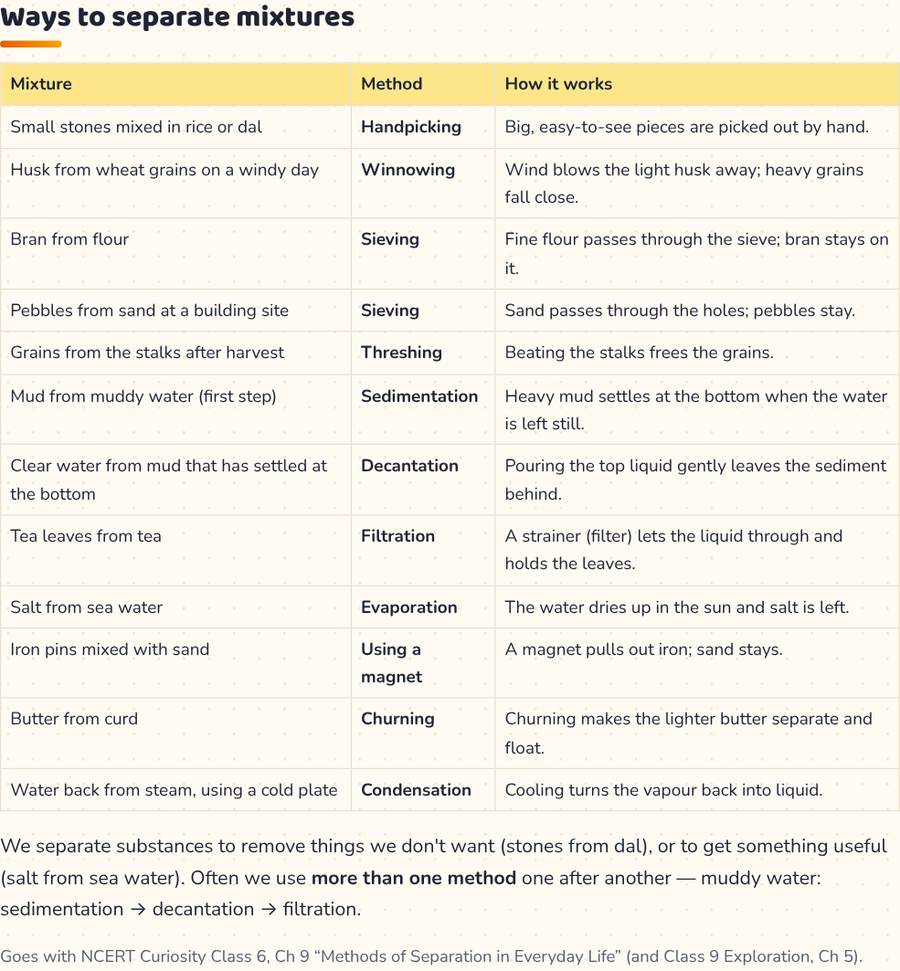
Ways to separate mixtures
| Mixture | Method | How it works |
|---|---|---|
| Small stones mixed in rice or dal | Handpicking | Big, easy-to-see pieces are picked out by hand. |
| Husk from wheat grains on a windy day | Winnowing | Wind blows the light husk away; heavy grains fall close. |
| Bran from flour | Sieving | Fine flour passes through the sieve; bran stays on it. |
| Pebbles from sand at a building site | Sieving | Sand passes through the holes; pebbles stay. |
| Grains from the stalks after harvest | Threshing | Beating the stalks frees the grains. |
| Mud from muddy water (first step) | Sedimentation | Heavy mud settles at the bottom when the water is left still. |
| Clear water from mud that has settled at the bottom | Decantation | Pouring the top liquid gently leaves the sediment behind. |
| Tea leaves from tea | Filtration | A strainer (filter) lets the liquid through and holds the leaves. |
| Salt from sea water | Evaporation | The water dries up in the sun and salt is left. |
| Iron pins mixed with sand | Using a magnet | A magnet pulls out iron; sand stays. |
| Butter from curd | Churning | Churning makes the lighter butter separate and float. |
| Water back from steam, using a cold plate | Condensation | Cooling turns the vapour back into liquid. |
We separate substances to remove things we don't want (stones from dal), or to get something useful (salt from sea water). Often we use more than one method one after another — muddy water: sedimentation → decantation → filtration.
Goes with NCERT Curiosity Class 6, Ch 9 “Methods of Separation in Everyday Life” (and Class 9 Exploration, Ch 5).
A one-page chart to stick on the wall, and a worksheet to practise.
Separation of substances
| Mixture | Method | How it works |
|---|---|---|
| Small stones mixed in rice or dal | Handpicking | Big, easy-to-see pieces are picked out by hand. |
| Husk from wheat grains on a windy day | Winnowing | Wind blows the light husk away; heavy grains fall close. |
| Bran from flour | Sieving | Fine flour passes through the sieve; bran stays on it. |
| Pebbles from sand at a building site | Sieving | Sand passes through the holes; pebbles stay. |
| Grains from the stalks after harvest | Threshing | Beating the stalks frees the grains. |
| Mud from muddy water (first step) | Sedimentation | Heavy mud settles at the bottom when the water is left still. |
| Clear water from mud that has settled at the bottom | Decantation | Pouring the top liquid gently leaves the sediment behind. |
| Tea leaves from tea | Filtration | A strainer (filter) lets the liquid through and holds the leaves. |
| Salt from sea water | Evaporation | The water dries up in the sun and salt is left. |
| Iron pins mixed with sand | Using a magnet | A magnet pulls out iron; sand stays. |
| Butter from curd | Churning | Churning makes the lighter butter separate and float. |
| Water back from steam, using a cold plate | Condensation | Cooling turns the vapour back into liquid. |
kheloaurseekho.in — free charts, games and worksheets
Separation of substances — worksheet
Name: ____________________ Class: ______ Date: __________
1. Stones from rice: ______________ Husk from grain: ______________
2. Salt from sea water: ______________ Tea leaves from tea: ______________
3. Write the three steps to clean muddy water: ______ → ______ → ______
4. How is winnowing different from sieving? ______________________
kheloaurseekho.in — free charts, games and worksheets