Balancing chemical equations · रासायनिक समीकरण संतुलित करना
Pick the right numbers so every atom is counted on both sides.
Balancing chemical equations games
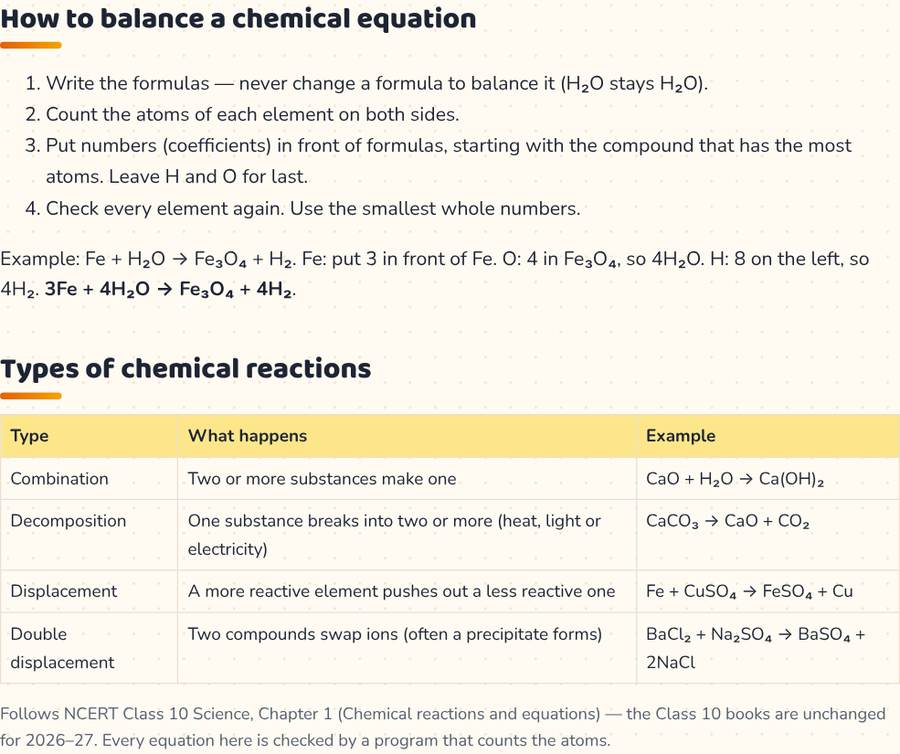
How to balance a chemical equation
- Write the formulas — never change a formula to balance it (H₂O stays H₂O).
- Count the atoms of each element on both sides.
- Put numbers (coefficients) in front of formulas, starting with the compound that has the most atoms. Leave H and O for last.
- Check every element again. Use the smallest whole numbers.
Example: Fe + H₂O → Fe₃O₄ + H₂. Fe: put 3 in front of Fe. O: 4 in Fe₃O₄, so 4H₂O. H: 8 on the left, so 4H₂. 3Fe + 4H₂O → Fe₃O₄ + 4H₂.
Types of chemical reactions
| Type | What happens | Example |
|---|---|---|
| Combination | Two or more substances make one | CaO + H₂O → Ca(OH)₂ |
| Decomposition | One substance breaks into two or more (heat, light or electricity) | CaCO₃ → CaO + CO₂ |
| Displacement | A more reactive element pushes out a less reactive one | Fe + CuSO₄ → FeSO₄ + Cu |
| Double displacement | Two compounds swap ions (often a precipitate forms) | BaCl₂ + Na₂SO₄ → BaSO₄ + 2NaCl |
Follows NCERT Class 10 Science, Chapter 1 (Chemical reactions and equations) — the Class 10 books are unchanged for 2026–27. Every equation here is checked by a program that counts the atoms.
A one-page chart to stick on the wall, and a worksheet to practise.
Balancing chemical equations
- 2H₂ + O₂ → 2H₂O
- 2Mg + O₂ → 2MgO
- N₂ + 3H₂ → 2NH₃
- CH₄ + 2O₂ → CO₂ + 2H₂O
- 2Na + 2H₂O → 2NaOH + H₂
- 4Al + 3O₂ → 2Al₂O₃
- Zn + 2HCl → ZnCl₂ + H₂
- 3Fe + 4H₂O → Fe₃O₄ + 4H₂
- 2KClO₃ → 2KCl + 3O₂
- 2Pb(NO₃)₂ → 2PbO + 4NO₂ + O₂
- BaCl₂ + Na₂SO₄ → BaSO₄ + 2NaCl
- C₃H₈ + 5O₂ → 3CO₂ + 4H₂O
- Fe₂O₃ + 2Al → Al₂O₃ + 2Fe
- 2H₂O₂ → 2H₂O + O₂
kheloaurseekho.in — free charts, games and worksheets
Balancing chemical equations — worksheet
Name: ____________________ Class: ______ Date: __________
1. __ P₄ + __ O₂ → __ P₄O₁₀
2. __ C₆H₁₂O₆ + __ O₂ → __ CO₂ + __ H₂O
3. __ AgCl → __ Ag + __ Cl₂
4. __ Cu + __ O₂ → __ CuO
5. __ Fe + __ Cl₂ → __ FeCl₃
6. __ NH₃ + __ O₂ → __ NO + __ H₂O
7. Name the type: CaCO₃ → CaO + CO₂ ______ Fe + CuSO₄ → FeSO₄ + Cu ______
kheloaurseekho.in — free charts, games and worksheets