Metals and non-metals · धातु और अधातु
Test materials in the virtual lab, learn the differences and the famous exceptions, then play.
Metals and non-metals games
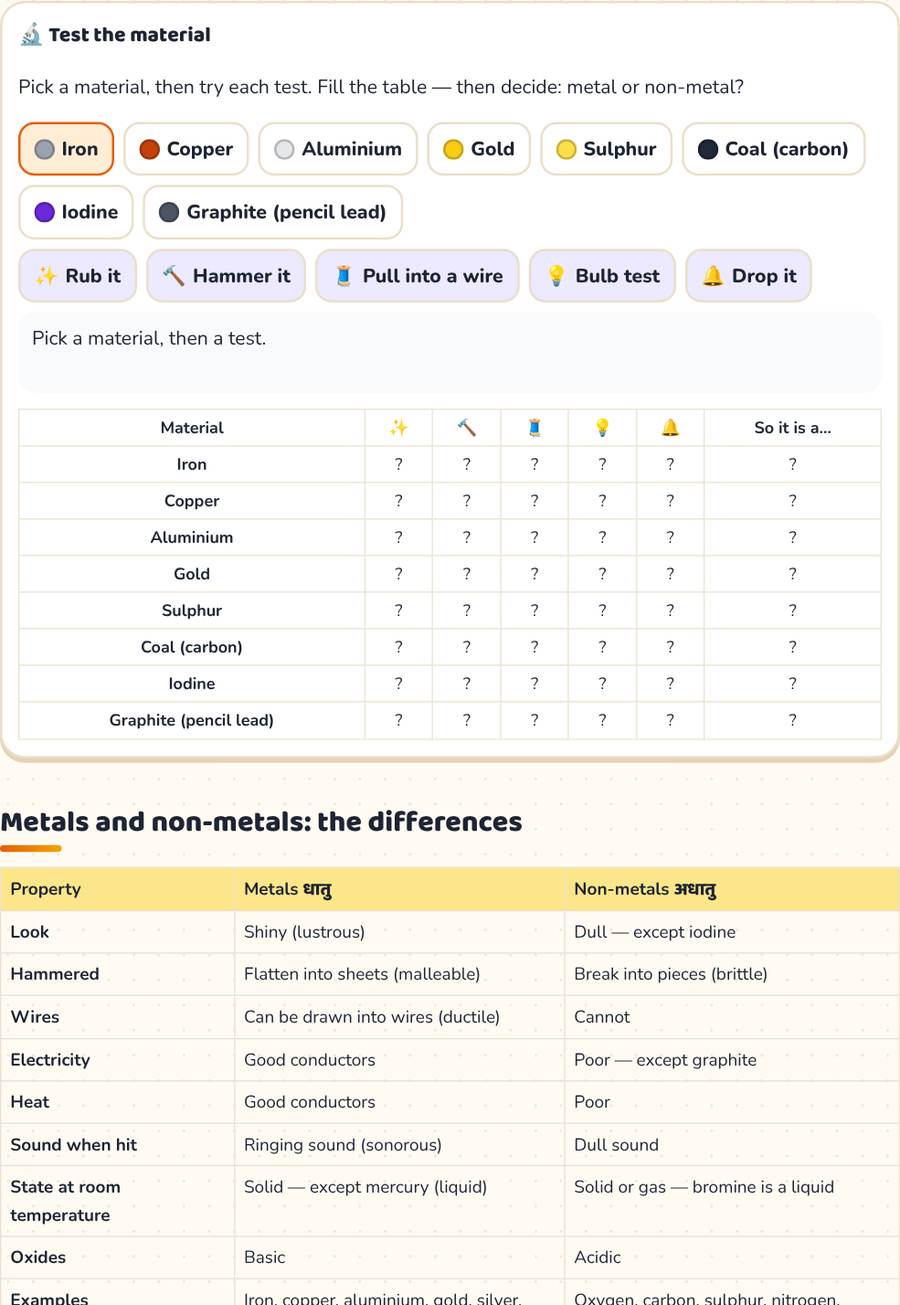
🔬 Test the material
Pick a material, then try each test. Fill the table — then decide: metal or non-metal?
Pick a material, then a test.
| Material | ✨ | 🔨 | 🧵 | 💡 | 🔔 | So it is a… |
|---|
Metals and non-metals: the differences
| Property | Metals धातु | Non-metals अधातु |
|---|---|---|
| Look | Shiny (lustrous) | Dull — except iodine |
| Hammered | Flatten into sheets (malleable) | Break into pieces (brittle) |
| Wires | Can be drawn into wires (ductile) | Cannot |
| Electricity | Good conductors | Poor — except graphite |
| Heat | Good conductors | Poor |
| Sound when hit | Ringing sound (sonorous) | Dull sound |
| State at room temperature | Solid — except mercury (liquid) | Solid or gas — bromine is a liquid |
| Oxides | Basic | Acidic |
| Examples | Iron, copper, aluminium, gold, silver, zinc | Oxygen, carbon, sulphur, nitrogen, iodine |
The odd ones out
- Mercury is a metal but a liquid at room temperature.
- Sodium and potassium are metals so soft they can be cut with a knife. They are kept in kerosene.
- Gallium (and caesium) melt on your palm.
- Iodine is a non-metal but it is shiny. Graphite is a non-metal but it conducts electricity.
- Diamond, a form of carbon (non-metal), is the hardest natural substance.
- Bromine is the only non-metal that is a liquid. Phosphorus is kept in water because it catches fire in air.
Facts follow NCERT Science Class 8 (Materials: Metals and Non-Metals) and Class 10. The lab shows what you would see in the NCERT activities — don't try the sodium or phosphorus facts at home!
A one-page chart to stick on the wall, and a worksheet to practise.
Metals and non-metals
| Property | Metals धातु | Non-metals अधातु |
|---|---|---|
| Look | Shiny (lustrous) | Dull — except iodine |
| Hammered | Flatten into sheets (malleable) | Break into pieces (brittle) |
| Wires | Can be drawn into wires (ductile) | Cannot |
| Electricity | Good conductors | Poor — except graphite |
| Heat | Good conductors | Poor |
| Sound when hit | Ringing sound (sonorous) | Dull sound |
| State at room temperature | Solid — except mercury (liquid) | Solid or gas — bromine is a liquid |
| Oxides | Basic | Acidic |
| Examples | Iron, copper, aluminium, gold, silver, zinc | Oxygen, carbon, sulphur, nitrogen, iodine |
Exceptions
- Mercury is a metal but a liquid at room temperature.
- Sodium and potassium are metals so soft they can be cut with a knife. They are kept in kerosene.
- Gallium (and caesium) melt on your palm.
- Iodine is a non-metal but it is shiny. Graphite is a non-metal but it conducts electricity.
- Diamond, a form of carbon (non-metal), is the hardest natural substance.
- Bromine is the only non-metal that is a liquid. Phosphorus is kept in water because it catches fire in air.
kheloaurseekho.in — free charts, games and worksheets
Metals and non-metals — worksheet
Name: ____________________ Class: ______ Date: __________
1. Write M (metal) or N (non-metal): iron ___ sulphur ___ copper ___ oxygen ___ gold ___ carbon ___
2. Metals can be beaten into thin sheets. This property is called ______________.
3. Metals can be drawn into wires. This property is called ______________.
4. Name the metal that is a liquid at room temperature: ______________
5. Name the non-metal that is a liquid at room temperature: ______________
6. Name a non-metal that conducts electricity: ______________
7. Why is sodium kept in kerosene? ___________________________________________
8. Why are electric wires made of copper? ___________________________________________
9. What happens when you hammer a piece of coal? ___________________________________
10. Metal oxides are ______________ and non-metal oxides are ______________.
kheloaurseekho.in — free charts, games and worksheets