States of matter · पदार्थ की अवस्थाएँ
Heat ice into steam in the particle lab, then play: sort things into solid, liquid or gas, and name each change of state.
States of matter games
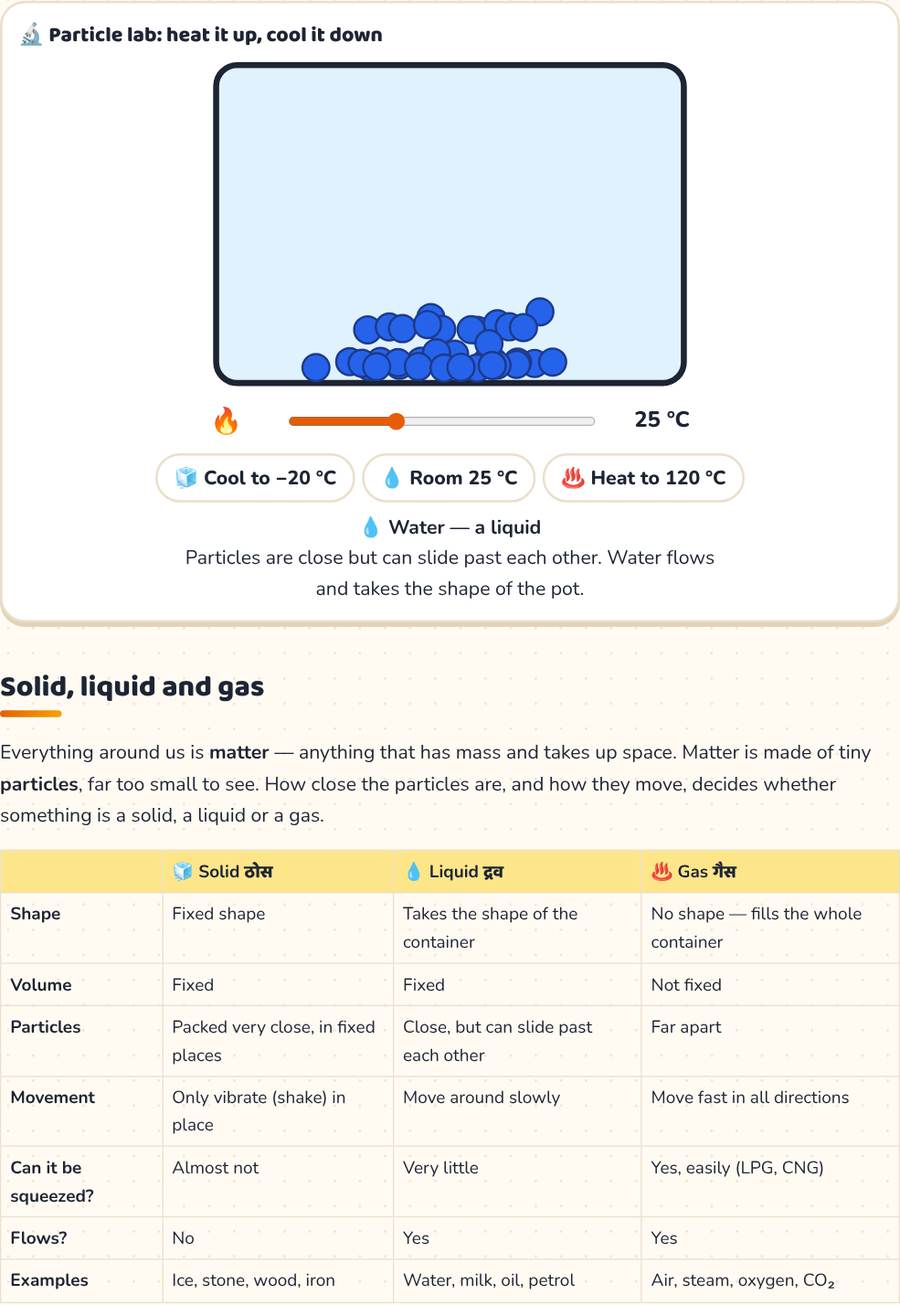
🔬 Particle lab: heat it up, cool it down
Solid, liquid and gas
Everything around us is matter — anything that has mass and takes up space. Matter is made of tiny particles, far too small to see. How close the particles are, and how they move, decides whether something is a solid, a liquid or a gas.
| 🧊 Solid ठोस | 💧 Liquid द्रव | ♨️ Gas गैस | |
|---|---|---|---|
| Shape | Fixed shape | Takes the shape of the container | No shape — fills the whole container |
| Volume | Fixed | Fixed | Not fixed |
| Particles | Packed very close, in fixed places | Close, but can slide past each other | Far apart |
| Movement | Only vibrate (shake) in place | Move around slowly | Move fast in all directions |
| Can it be squeezed? | Almost not | Very little | Yes, easily (LPG, CNG) |
| Flows? | No | Yes | Yes |
| Examples | Ice, stone, wood, iron | Water, milk, oil, petrol | Air, steam, oxygen, CO₂ |
Changing state
Heating or cooling can change matter from one state to another. The particles stay the same — only their spacing and movement change.
| Change | From → to | Example |
|---|---|---|
| Melting गलन | Solid → liquid | Ice melts at 0 °C |
| Freezing हिमीकरण (जमना) | Liquid → solid | Water turns to ice at 0 °C |
| Evaporation वाष्पीकरण | Liquid → gas (slowly, from the surface, any temperature) | Wet clothes dry |
| Boiling क्वथन | Liquid → gas (fast, all through, at a fixed temperature) | Water boils at 100 °C |
| Condensation संघनन | Gas → liquid | Dew; drops on a cold glass |
| Sublimation ऊर्ध्वपातन | Solid → gas directly | Camphor, naphthalene balls, dry ice |
Evaporation causes cooling: that is why water in a matka stays cool and why we feel cool when sweat dries. Facts follow NCERT Science (Class 6–9).
A one-page chart to stick on the wall, and a worksheet to practise.
States of matter
| 🧊 Solid ठोस | 💧 Liquid द्रव | ♨️ Gas गैस | |
|---|---|---|---|
| Shape | Fixed shape | Takes the shape of the container | No shape — fills the whole container |
| Volume | Fixed | Fixed | Not fixed |
| Particles | Packed very close, in fixed places | Close, but can slide past each other | Far apart |
| Movement | Only vibrate (shake) in place | Move around slowly | Move fast in all directions |
| Can it be squeezed? | Almost not | Very little | Yes, easily (LPG, CNG) |
| Flows? | No | Yes | Yes |
| Examples | Ice, stone, wood, iron | Water, milk, oil, petrol | Air, steam, oxygen, CO₂ |
| Change | From → to | Example |
|---|---|---|
| Melting गलन | Solid → liquid | Ice melts at 0 °C |
| Freezing हिमीकरण (जमना) | Liquid → solid | Water turns to ice at 0 °C |
| Evaporation वाष्पीकरण | Liquid → gas (slowly, from the surface, any temperature) | Wet clothes dry |
| Boiling क्वथन | Liquid → gas (fast, all through, at a fixed temperature) | Water boils at 100 °C |
| Condensation संघनन | Gas → liquid | Dew; drops on a cold glass |
| Sublimation ऊर्ध्वपातन | Solid → gas directly | Camphor, naphthalene balls, dry ice |
kheloaurseekho.in — free charts, games and worksheets
States of matter — worksheet
Name: ____________________ Class: ______ Date: __________
kheloaurseekho.in — free charts, games and worksheets