Human digestive system · पाचन तंत्र
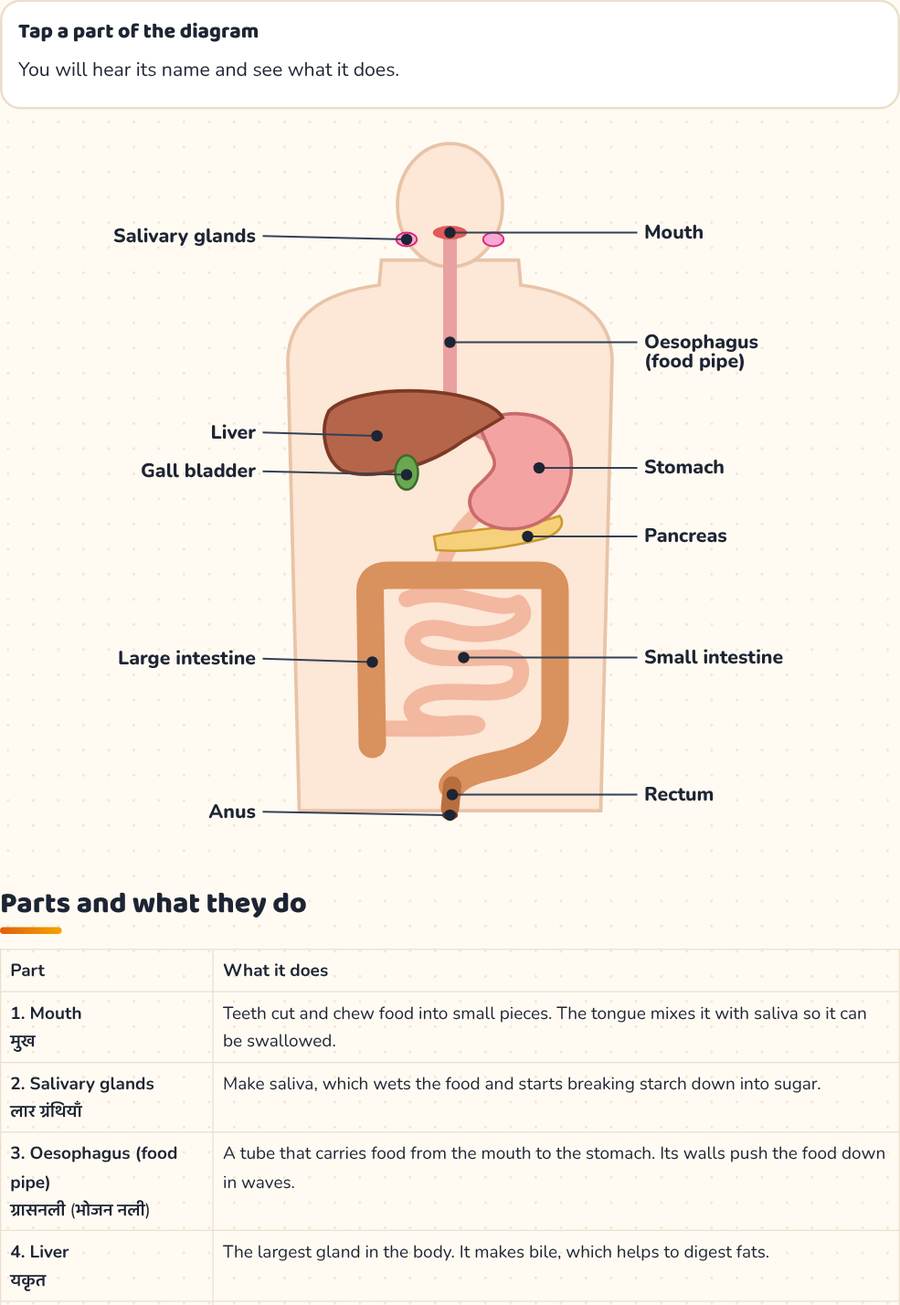
When we eat, our body breaks food down into tiny pieces that can pass into the blood. This is digestion. Food travels through one long tube — the alimentary canal — from the mouth to the anus.
Human digestive system games
Tap a part of the diagram
You will hear its name and see what it does.
Parts and what they do
| Part | What it does |
|---|---|
| 1. Mouth मुख | Teeth cut and chew food into small pieces. The tongue mixes it with saliva so it can be swallowed. |
| 2. Salivary glands लार ग्रंथियाँ | Make saliva, which wets the food and starts breaking starch down into sugar. |
| 3. Oesophagus (food pipe) ग्रासनली (भोजन नली) | A tube that carries food from the mouth to the stomach. Its walls push the food down in waves. |
| 4. Liver यकृत | The largest gland in the body. It makes bile, which helps to digest fats. |
| 5. Gall bladder पित्ताशय | A small bag that stores bile made by the liver. |
| 6. Stomach आमाशय | Churns the food. It makes acid that kills germs and juices that start digesting proteins. |
| 7. Pancreas अग्न्याशय | Makes pancreatic juice, which digests carbohydrates, proteins and fats. |
| 8. Small intestine छोटी आँत (क्षुद्रांत्र) | The longest part (about 7.5 m). Digestion is completed here and digested food passes into the blood. |
| 9. Large intestine बड़ी आँत (बृहदांत्र) | Wider and shorter (about 1.5 m). It takes in water and some salts from the undigested food. |
| 10. Rectum मलाशय | Stores the waste (faeces) for some time. |
| 11. Anus गुदा | The opening through which waste leaves the body. |
The path of food
Mouth → Oesophagus → Stomach → Small intestine → Large intestine → Rectum → Anus
The liver, gall bladder, pancreas and salivary glands are glands. Food does not pass through them, but their juices help to digest it.
Five steps of nutrition
- Ingestion — taking food into the mouth.
- Digestion — breaking food into simple, soluble parts.
- Absorption — digested food passes into the blood (in the small intestine).
- Assimilation — the body uses the food to make new parts and get energy.
- Egestion — removing the undigested waste through the anus.
Fact: the inner wall of the small intestine has thousands of finger-like villi that give it a huge surface to absorb food.
The chart has the labelled diagram and what each part does. The worksheet has the diagram with blank labels and questions.
Human digestive system · पाचन तंत्र
| Part | What it does |
|---|---|
| 1. Mouth मुख | Teeth cut and chew food into small pieces. The tongue mixes it with saliva so it can be swallowed. |
| 2. Salivary glands लार ग्रंथियाँ | Make saliva, which wets the food and starts breaking starch down into sugar. |
| 3. Oesophagus (food pipe) ग्रासनली (भोजन नली) | A tube that carries food from the mouth to the stomach. Its walls push the food down in waves. |
| 4. Liver यकृत | The largest gland in the body. It makes bile, which helps to digest fats. |
| 5. Gall bladder पित्ताशय | A small bag that stores bile made by the liver. |
| 6. Stomach आमाशय | Churns the food. It makes acid that kills germs and juices that start digesting proteins. |
| 7. Pancreas अग्न्याशय | Makes pancreatic juice, which digests carbohydrates, proteins and fats. |
| 8. Small intestine छोटी आँत (क्षुद्रांत्र) | The longest part (about 7.5 m). Digestion is completed here and digested food passes into the blood. |
| 9. Large intestine बड़ी आँत (बृहदांत्र) | Wider and shorter (about 1.5 m). It takes in water and some salts from the undigested food. |
| 10. Rectum मलाशय | Stores the waste (faeces) for some time. |
| 11. Anus गुदा | The opening through which waste leaves the body. |
kheloaurseekho.in/science/human-digestive-system/
Human digestive system — worksheet
Name: ____________________ Date: __________
A. Label the parts of the diagram.
B. Answer these.
Answers: kheloaurseekho.in/science/human-digestive-system/
More science: Human respiratory system · Plant cell diagram · Animal cell diagram · Solar system · Photosynthesis · Human brain · Human heart · Human eye · Parts of a flower · Parts of a plant · Periodic table · Water cycle