Parts of a flower · फूल के भाग
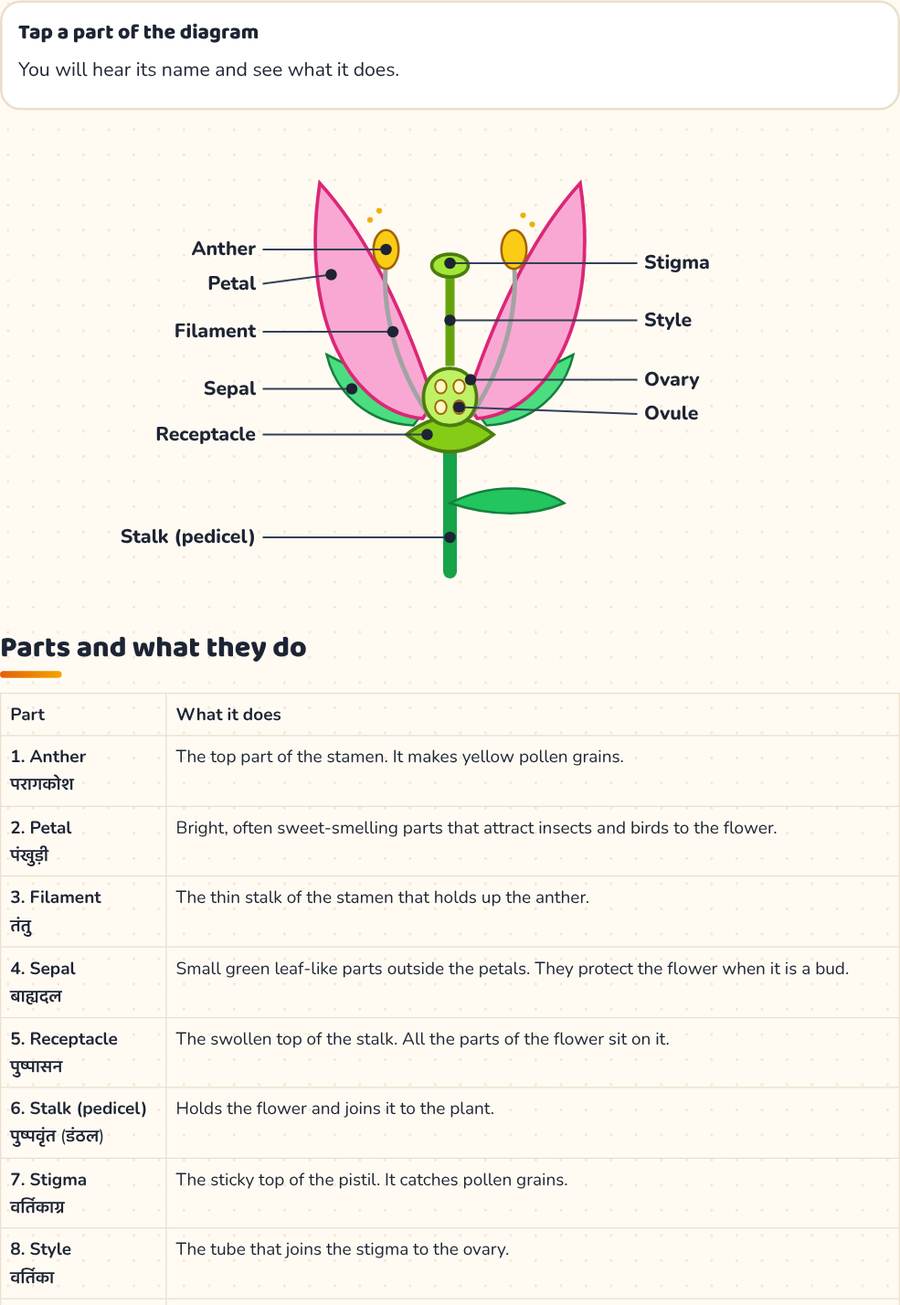
A flower is the part of a plant that makes seeds. Most flowers have sepals, petals, stamens (the male part) and a pistil (the female part).
Parts of a flower games
Tap a part of the diagram
You will hear its name and see what it does.
Parts and what they do
| Part | What it does |
|---|---|
| 1. Anther परागकोश | The top part of the stamen. It makes yellow pollen grains. |
| 2. Petal पंखुड़ी | Bright, often sweet-smelling parts that attract insects and birds to the flower. |
| 3. Filament तंतु | The thin stalk of the stamen that holds up the anther. |
| 4. Sepal बाह्यदल | Small green leaf-like parts outside the petals. They protect the flower when it is a bud. |
| 5. Receptacle पुष्पासन | The swollen top of the stalk. All the parts of the flower sit on it. |
| 6. Stalk (pedicel) पुष्पवृंत (डंठल) | Holds the flower and joins it to the plant. |
| 7. Stigma वर्तिकाग्र | The sticky top of the pistil. It catches pollen grains. |
| 8. Style वर्तिका | The tube that joins the stigma to the ovary. |
| 9. Ovary अंडाशय | The swollen base of the pistil. After fertilisation it becomes the fruit. |
| 10. Ovule बीजांड | Tiny parts inside the ovary. After fertilisation each ovule becomes a seed. |
Stamen and pistil
- Stamen (पुंकेसर) = anther + filament. It is the male part and makes pollen.
- Pistil (स्त्रीकेसर) = stigma + style + ovary. It is the female part and has the ovules.
From flower to fruit
Pollen lands on the stigma → pollen tube grows down the style → fertilisation in the ovule → ovule becomes seed → ovary becomes fruit
Moving pollen from the anther to the stigma is called pollination. Insects, birds, wind and water carry pollen.
Try it: cut a flower such as a hibiscus (gudhal) or a mustard flower in half and find each part with a magnifying glass.
The chart has the labelled diagram and what each part does. The worksheet has the diagram with blank labels and questions.
Parts of a flower · फूल के भाग
| Part | What it does |
|---|---|
| 1. Anther परागकोश | The top part of the stamen. It makes yellow pollen grains. |
| 2. Petal पंखुड़ी | Bright, often sweet-smelling parts that attract insects and birds to the flower. |
| 3. Filament तंतु | The thin stalk of the stamen that holds up the anther. |
| 4. Sepal बाह्यदल | Small green leaf-like parts outside the petals. They protect the flower when it is a bud. |
| 5. Receptacle पुष्पासन | The swollen top of the stalk. All the parts of the flower sit on it. |
| 6. Stalk (pedicel) पुष्पवृंत (डंठल) | Holds the flower and joins it to the plant. |
| 7. Stigma वर्तिकाग्र | The sticky top of the pistil. It catches pollen grains. |
| 8. Style वर्तिका | The tube that joins the stigma to the ovary. |
| 9. Ovary अंडाशय | The swollen base of the pistil. After fertilisation it becomes the fruit. |
| 10. Ovule बीजांड | Tiny parts inside the ovary. After fertilisation each ovule becomes a seed. |
kheloaurseekho.in/science/parts-of-a-flower/
Parts of a flower — worksheet
Name: ____________________ Date: __________
A. Label the parts of the diagram.
B. Answer these.
Answers: kheloaurseekho.in/science/parts-of-a-flower/
More science: Human digestive system · Human respiratory system · Plant cell diagram · Animal cell diagram · Solar system · Photosynthesis · Human brain · Human heart · Human eye · Parts of a plant · Periodic table · Water cycle