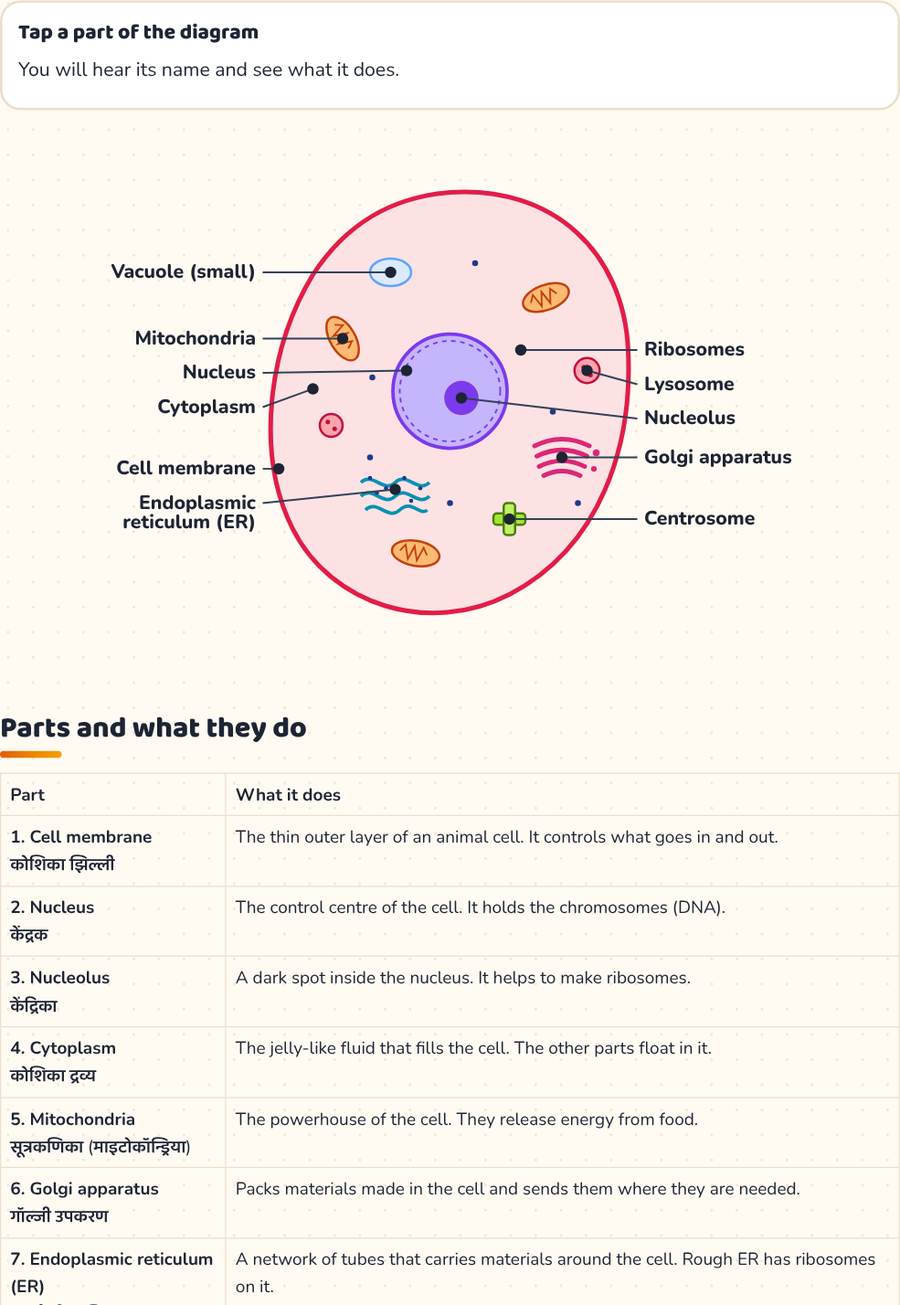
Animal cell diagram · जंतु कोशिका
Our body is made of millions of millions of cells. An animal cell has a thin cell membrane but no cell wall, so it is usually round or irregular in shape.
Animal cell diagram games
Tap a part of the diagram
You will hear its name and see what it does.
Parts and what they do
| Part | What it does |
|---|---|
| 1. Cell membrane कोशिका झिल्ली | The thin outer layer of an animal cell. It controls what goes in and out. |
| 2. Nucleus केंद्रक | The control centre of the cell. It holds the chromosomes (DNA). |
| 3. Nucleolus केंद्रिका | A dark spot inside the nucleus. It helps to make ribosomes. |
| 4. Cytoplasm कोशिका द्रव्य | The jelly-like fluid that fills the cell. The other parts float in it. |
| 5. Mitochondria सूत्रकणिका (माइटोकॉन्ड्रिया) | The powerhouse of the cell. They release energy from food. |
| 6. Golgi apparatus गॉल्जी उपकरण | Packs materials made in the cell and sends them where they are needed. |
| 7. Endoplasmic reticulum (ER) अंतर्द्रव्यी जालिका | A network of tubes that carries materials around the cell. Rough ER has ribosomes on it. |
| 8. Ribosomes राइबोसोम | Tiny dots that make proteins. |
| 9. Lysosome लयनकाय (लाइसोसोम) | A small sac of digestive juices that breaks down waste and worn-out parts. Called the 'suicide bag' of the cell. |
| 10. Centrosome तारककाय | Helps the cell to divide. Found in animal cells. |
| 11. Vacuole (small) रसधानी (छोटी) | Small sacs that store water and waste. Animal cells have small vacuoles or none. |
Animal cell and plant cell
| Plant cell | Animal cell |
|---|---|
| Has a cell wall outside the cell membrane | No cell wall — only a cell membrane |
| Has chloroplasts (makes its own food) | No chloroplasts |
| One large central vacuole | Small vacuoles, or none |
| Usually has a fixed, box-like shape | Usually round or irregular in shape |
| Centrosome usually absent | Has a centrosome |
See the plant cell diagram.
The chart has the labelled diagram and what each part does. The worksheet has the diagram with blank labels and questions.
Animal cell diagram · जंतु कोशिका
| Part | What it does |
|---|---|
| 1. Cell membrane कोशिका झिल्ली | The thin outer layer of an animal cell. It controls what goes in and out. |
| 2. Nucleus केंद्रक | The control centre of the cell. It holds the chromosomes (DNA). |
| 3. Nucleolus केंद्रिका | A dark spot inside the nucleus. It helps to make ribosomes. |
| 4. Cytoplasm कोशिका द्रव्य | The jelly-like fluid that fills the cell. The other parts float in it. |
| 5. Mitochondria सूत्रकणिका (माइटोकॉन्ड्रिया) | The powerhouse of the cell. They release energy from food. |
| 6. Golgi apparatus गॉल्जी उपकरण | Packs materials made in the cell and sends them where they are needed. |
| 7. Endoplasmic reticulum (ER) अंतर्द्रव्यी जालिका | A network of tubes that carries materials around the cell. Rough ER has ribosomes on it. |
| 8. Ribosomes राइबोसोम | Tiny dots that make proteins. |
| 9. Lysosome लयनकाय (लाइसोसोम) | A small sac of digestive juices that breaks down waste and worn-out parts. Called the 'suicide bag' of the cell. |
| 10. Centrosome तारककाय | Helps the cell to divide. Found in animal cells. |
| 11. Vacuole (small) रसधानी (छोटी) | Small sacs that store water and waste. Animal cells have small vacuoles or none. |
kheloaurseekho.in/science/animal-cell-diagram/
Animal cell diagram — worksheet
Name: ____________________ Date: __________
A. Label the parts of the diagram.
B. Answer these.
Answers: kheloaurseekho.in/science/animal-cell-diagram/
More science: Human digestive system · Human respiratory system · Plant cell diagram · Solar system · Photosynthesis · Human brain · Human heart · Human eye · Parts of a flower · Parts of a plant · Periodic table · Water cycle