Human respiratory system · श्वसन तंत्र
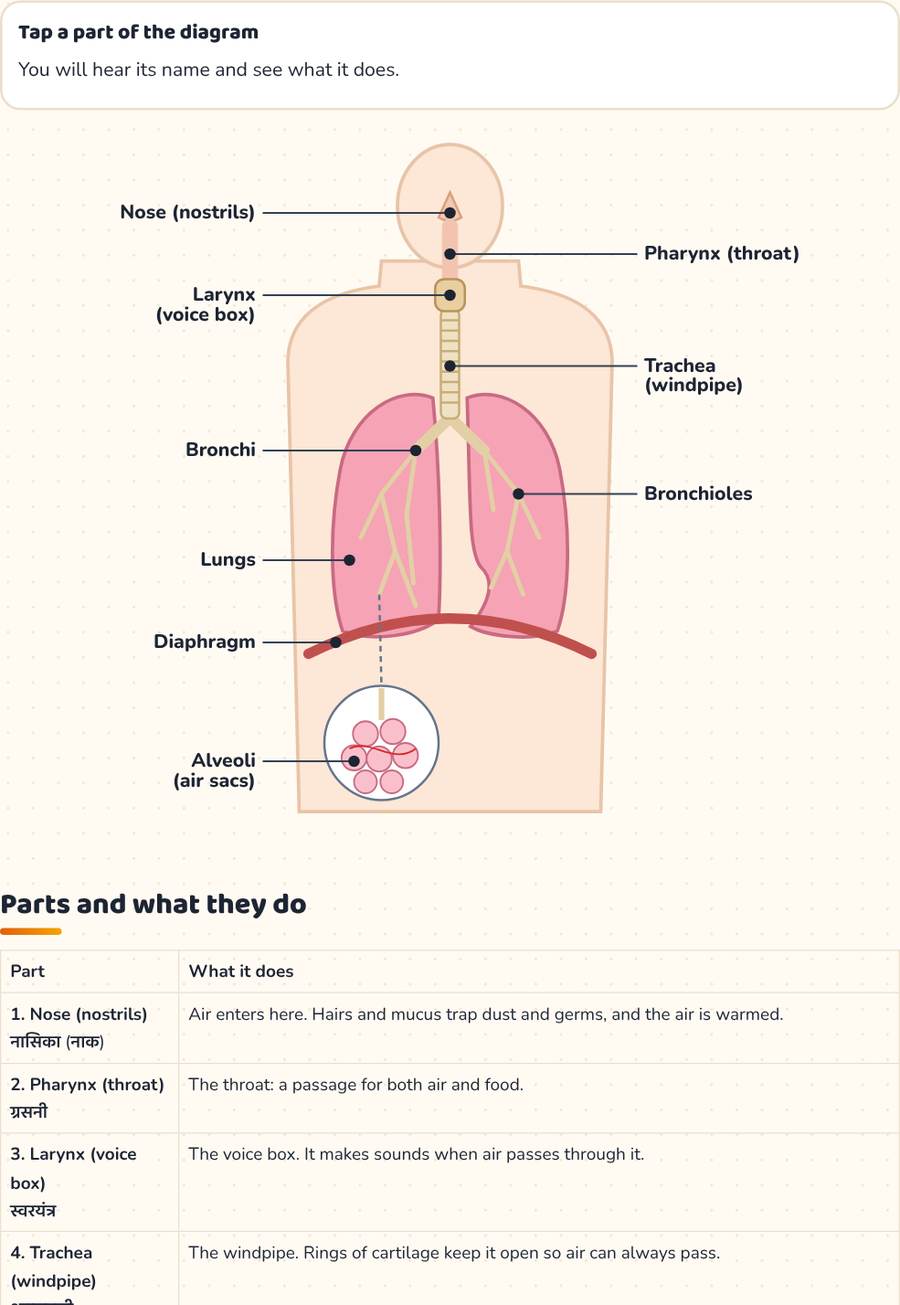
We breathe in air to take oxygen into the body and breathe out carbon dioxide. The parts that do this make up the respiratory system.
Human respiratory system games
Tap a part of the diagram
You will hear its name and see what it does.
Parts and what they do
| Part | What it does |
|---|---|
| 1. Nose (nostrils) नासिका (नाक) | Air enters here. Hairs and mucus trap dust and germs, and the air is warmed. |
| 2. Pharynx (throat) ग्रसनी | The throat: a passage for both air and food. |
| 3. Larynx (voice box) स्वरयंत्र | The voice box. It makes sounds when air passes through it. |
| 4. Trachea (windpipe) श्वासनली | The windpipe. Rings of cartilage keep it open so air can always pass. |
| 5. Bronchi श्वसनी | The windpipe splits into two bronchi, one going to each lung. |
| 6. Bronchioles श्वसनिकाएँ | Smaller and smaller tubes inside the lungs, like branches of a tree. |
| 7. Lungs फेफड़े (फुफ्फुस) | Two soft, spongy organs in the chest. Here oxygen goes into the blood and carbon dioxide comes out. |
| 8. Alveoli (air sacs) कूपिकाएँ | Millions of tiny air sacs at the ends of the bronchioles. Oxygen passes into the blood through their thin walls. |
| 9. Diaphragm डायाफ्राम (मध्यपट) | A sheet of muscle under the lungs. It moves down when we breathe in and up when we breathe out. |
The path of air
Nose → Pharynx → Larynx → Trachea → Bronchi → Bronchioles → Alveoli
How do we breathe?
- Breathing in (inhalation): the diaphragm moves down and the ribs move up and out. The chest gets bigger, so air rushes into the lungs.
- Breathing out (exhalation): the diaphragm moves up and the ribs move down and in. The chest gets smaller and air is pushed out.
At rest, an adult breathes in and out about 15 to 18 times a minute. After running or exercise we breathe faster.
Breathing is taking air in and out. Respiration is what happens inside the cells, where oxygen is used to release energy from food.
The chart has the labelled diagram and what each part does. The worksheet has the diagram with blank labels and questions.
Human respiratory system · श्वसन तंत्र
| Part | What it does |
|---|---|
| 1. Nose (nostrils) नासिका (नाक) | Air enters here. Hairs and mucus trap dust and germs, and the air is warmed. |
| 2. Pharynx (throat) ग्रसनी | The throat: a passage for both air and food. |
| 3. Larynx (voice box) स्वरयंत्र | The voice box. It makes sounds when air passes through it. |
| 4. Trachea (windpipe) श्वासनली | The windpipe. Rings of cartilage keep it open so air can always pass. |
| 5. Bronchi श्वसनी | The windpipe splits into two bronchi, one going to each lung. |
| 6. Bronchioles श्वसनिकाएँ | Smaller and smaller tubes inside the lungs, like branches of a tree. |
| 7. Lungs फेफड़े (फुफ्फुस) | Two soft, spongy organs in the chest. Here oxygen goes into the blood and carbon dioxide comes out. |
| 8. Alveoli (air sacs) कूपिकाएँ | Millions of tiny air sacs at the ends of the bronchioles. Oxygen passes into the blood through their thin walls. |
| 9. Diaphragm डायाफ्राम (मध्यपट) | A sheet of muscle under the lungs. It moves down when we breathe in and up when we breathe out. |
kheloaurseekho.in/science/human-respiratory-system/
Human respiratory system — worksheet
Name: ____________________ Date: __________
A. Label the parts of the diagram.
B. Answer these.
Answers: kheloaurseekho.in/science/human-respiratory-system/
More science: Human digestive system · Plant cell diagram · Animal cell diagram · Solar system · Photosynthesis · Human brain · Human heart · Human eye · Parts of a flower · Parts of a plant · Periodic table · Water cycle