Solar system · सौरमंडल
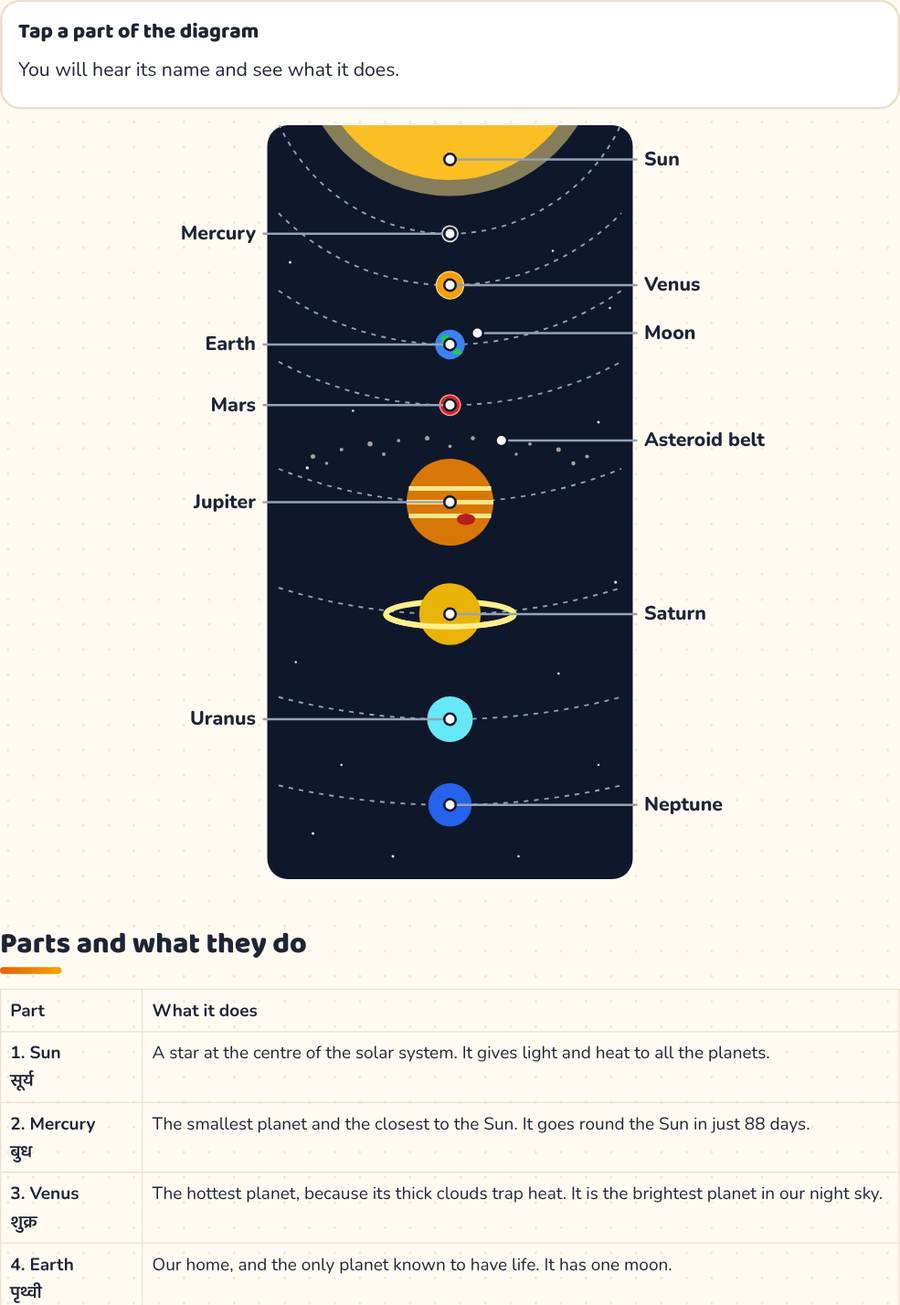
The solar system is the Sun and everything that goes round it: 8 planets, their moons, and millions of asteroids and comets. Tap the Sun or a planet to learn about it.
Solar system games
Tap a part of the diagram
You will hear its name and see what it does.
Parts and what they do
| Part | What it does |
|---|---|
| 1. Sun सूर्य | A star at the centre of the solar system. It gives light and heat to all the planets. |
| 2. Mercury बुध | The smallest planet and the closest to the Sun. It goes round the Sun in just 88 days. |
| 3. Venus शुक्र | The hottest planet, because its thick clouds trap heat. It is the brightest planet in our night sky. |
| 4. Earth पृथ्वी | Our home, and the only planet known to have life. It has one moon. |
| 5. Moon चंद्रमा | Earth's natural satellite. It goes round the Earth in about 27 days and shines by reflecting sunlight. |
| 6. Mars मंगल | The red planet, because of its rusty red dust. It has two small moons. |
| 7. Asteroid belt क्षुद्रग्रह पट्टी | Millions of rocky pieces called asteroids that go round the Sun between Mars and Jupiter. |
| 8. Jupiter बृहस्पति | The largest planet. Its Great Red Spot is a giant storm. |
| 9. Saturn शनि | Famous for its bright rings, made of pieces of ice and rock. |
| 10. Uranus अरुण (यूरेनस) | An ice giant that spins tipped over on its side. |
| 11. Neptune वरुण (नेप्च्यून) | The farthest planet from the Sun, with the strongest winds. |
The 8 planets in order
Mercury → Venus → Earth → Mars → Jupiter → Saturn → Uranus → Neptune
A trick to remember the order: My Very Educated Mother Just Served Us Noodles.
बुध → शुक्र → पृथ्वी → मंगल → बृहस्पति → शनि → अरुण → वरुण
Rocky planets and giant planets
- The 4 planets near the Sun — Mercury, Venus, Earth and Mars — are small and rocky.
- The 4 outer planets — Jupiter, Saturn, Uranus and Neptune — are giants made mostly of gas and ice. All four have rings.
Some facts
- Sunlight takes about 8 minutes to reach the Earth.
- Pluto was called the ninth planet until 2006. Now it is called a dwarf planet.
- The planets go round the Sun in paths called orbits. Earth takes about 365 days — one year — to go round once.
The diagram is not to scale: the real Sun is far bigger and the planets are much farther apart.
The chart has the labelled diagram and what each part does. The worksheet has the diagram with blank labels and questions.
Solar system · सौरमंडल
| Part | What it does |
|---|---|
| 1. Sun सूर्य | A star at the centre of the solar system. It gives light and heat to all the planets. |
| 2. Mercury बुध | The smallest planet and the closest to the Sun. It goes round the Sun in just 88 days. |
| 3. Venus शुक्र | The hottest planet, because its thick clouds trap heat. It is the brightest planet in our night sky. |
| 4. Earth पृथ्वी | Our home, and the only planet known to have life. It has one moon. |
| 5. Moon चंद्रमा | Earth's natural satellite. It goes round the Earth in about 27 days and shines by reflecting sunlight. |
| 6. Mars मंगल | The red planet, because of its rusty red dust. It has two small moons. |
| 7. Asteroid belt क्षुद्रग्रह पट्टी | Millions of rocky pieces called asteroids that go round the Sun between Mars and Jupiter. |
| 8. Jupiter बृहस्पति | The largest planet. Its Great Red Spot is a giant storm. |
| 9. Saturn शनि | Famous for its bright rings, made of pieces of ice and rock. |
| 10. Uranus अरुण (यूरेनस) | An ice giant that spins tipped over on its side. |
| 11. Neptune वरुण (नेप्च्यून) | The farthest planet from the Sun, with the strongest winds. |
kheloaurseekho.in/science/solar-system/
Solar system — worksheet
Name: ____________________ Date: __________
A. Label the parts of the diagram.
B. Answer these.
Answers: kheloaurseekho.in/science/solar-system/
More science: Human digestive system · Human respiratory system · Plant cell diagram · Animal cell diagram · Photosynthesis · Human brain · Human heart · Human eye · Parts of a flower · Parts of a plant · Periodic table · Water cycle